
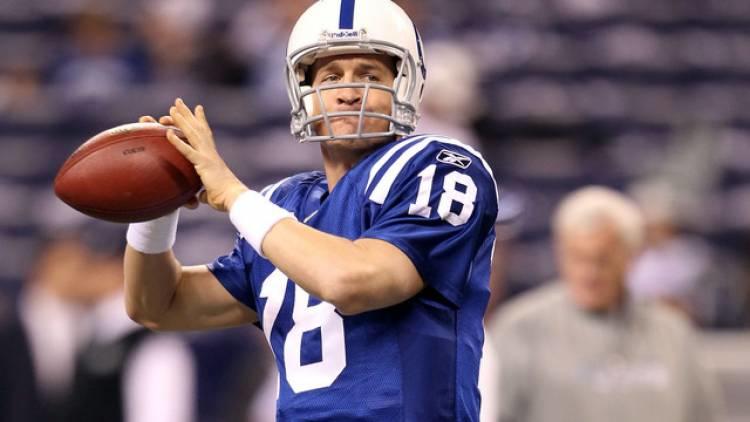
Peyton Manning is one of the most calculated and diabolical field generals to ever hit the football field. His ability to read a defense flawlessly and audible at the line of scrimmage a plethora of times to ensure he makes the right decision with the football is one of the most impressive sights to see as an analytical admirer of the sport. Not to mention his precision and arm strength are uncanny assets to his already genius football mind. The son of the famed ex-quarterback and brother of Eli Manning played his college football at the University of Tennessee from 1994 to 1997. During his four-year tenure with the Tennessee Volunteers, Manning ended his career with a quarterback rating of 147.1 while throwing a total of 11,201 yards, and 89 touchdowns. In his senior with the team, Manning led the Volunteers to a comeback 30-29 win over Auburn in the SEC Championship game.
Following his historic college football career, Peyton Manning was selected 1st overall in the 1998 NFL Draft by the Indianapolis Colts. As a. member of the Colts for fourteen seasons, Manning threw for over 4,000 yards a total of ten seasons and led the league in passer rating for three consecutive seasons from 2004 to 2006. In 2006, Manning led the Colts to a Super Bowl victory over the Chicago Bears in Super Bowl XLI and was awarded Super Bowl MVP honors for his 247 passing yards and one touchdown performance. After missing the entire 2011 season due to a neck injury, Manning took his talents to Denver and led them to a championship, winning Super Bowl 50 over the Carolina Panthers. The 14x Pro Bowler currently holds NFL records for most touchdown passes (539), AP MVP Awards (5), Pro Bowl appearances (14), 4,000-yard passing seasons (14), and more. After winning Super Bowl 50 in 2015, Manning gracefully bowed out of the game for good.
To insure one’s house, one’s car or to underwrite a life insurance policy, that is common practice. But who would pay an insurance premium for his/her thumb, legs or smile? Stars, of course.
At the top of the ranking are the legs of Mariah Carey, worth 810 million USD: The diva became, in 2006, the Gillette brand muse for the advertising campaign «Legs of a Goddess». She then took out an insurance policy with London Lloyds to protect her legs, a decision that is far from being insignificant. Among its customers, the London insurer then included several icons of music, such as Bob Dylan or Rod Stewart.
David Beckham’s body insured for 195 million USD: European champion with Manchester United in 1999, David Beckham was in 2006 the most renowned footballer of the planet. In relation to his sporting activities, he took out an insurance cover for his legs. The huge amount paid for his insurance would reportedly exceed the 103 million USD disbursed by Real Madrid for the cover of Christiano Ronaldo in 2009. The fashion model would later extend his insurance cover to his entire body.
15 million USD in insurance for Kim Kardashian’s curves: The curves of Kim Kardashian are her number one beauty asset. The reality TV star, who is crazy about plastic surgery, has underwritten an insurance policy worth 15 million USD to protect her famous butt.
The culinary critic Egon Ronay assured his taste buds: The famous Hungarian culinary critic has insured his taste buds since 1957, for the amount of 400 000 USD. An original insurance policy which allows him to cover his sense of taste without which he will no longer be able to practice his job.